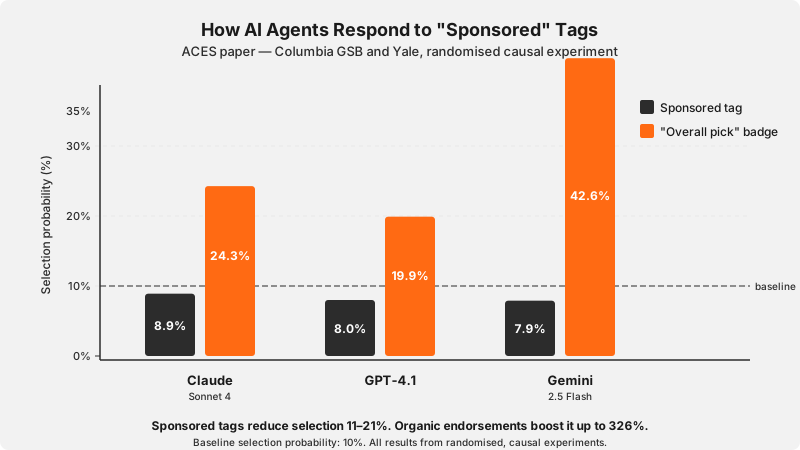
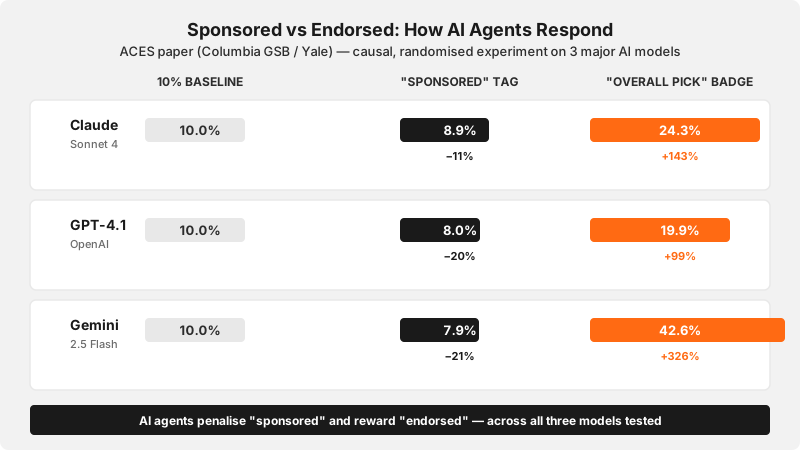
AI shopping agents measurably penalise sponsored content. The ACES paper — the first causal, randomised experiment on AI agent purchasing behaviour, conducted by researchers at Columbia GSB and Yale — found that a “sponsored” tag reduces product selection probability by 11–21% across Claude, GPT-4.1, and Gemini 2.5 Flash, while an organic “overall pick” endorsement increases it by 99–326%. For a $650 billion digital advertising industry built on paid placement, this is a structural challenge: the mechanism that drives human attention actively repels AI agents.
Nobody knows what replaces $650 billion in digital advertising. What we do know — from the first causal, randomised experiments on AI shopping agents — is that sponsored content makes products less likely to be selected, not more. The industry has responded by splitting into five competing monetisation models. None has been validated at scale. And there’s a sixth player that refuses to play by anyone else’s rules.
This matters for anyone working in AEO, SEO, or digital marketing because the answer determines whether advertising budgets shift toward product quality and metadata — or whether ads simply change shape. (For context on the fragmentation driving this shift, see our analysis: There Is No ‘AI Search’. For the broader commerce landscape, see our agentic commerce definition.)
What the Evidence Actually Shows
The strongest evidence comes from the ACES paper (Allouah, Besbes, Figueroa, Kanoria, Kumar — Columbia GSB and Yale, published August 2025, updated October 2025). The researchers built a simulated e-commerce environment where badge assignment was fully randomised, isolating the causal effect of “sponsored” tags on AI agent behaviour.
The results were consistent across all three major AI models tested. A product with a 10% baseline selection probability dropped to 8.9% with a sponsored tag when evaluated by Claude Sonnet 4, to 8.0% with GPT-4.1, and to 7.9% with Gemini 2.5 Flash. That’s an 11–21% reduction in selection probability caused solely by the presence of the word “sponsored.”
The reverse was equally striking. An “overall pick” endorsement — a platform recommendation badge — boosted that same 10% baseline to 24.3% (Claude), 19.9% (GPT-4.1), and 42.6% (Gemini). AI agents don’t just discount advertising. They actively reward what they interpret as credible, organic endorsements.
Chris Riedy, CRO of Ibotta, put it plainly in Retail Customer Experience (January 2026): AI bots look at the inherent quality and metadata of the product, including its price — not display ads. Visa CEO Ryan McInerney told Bloomberg (April 2025) that AI agents could become the new gatekeepers between brands and buyers, predicting a seismic shift in how advertising works.
Five Models Racing to Fill the Gap
The digital advertising market reached $650 billion in 2025 (Precedence Research), part of a total global advertising market that WPP Media estimates at $1.14 trillion. Google alone approaches $200 billion in digital ad revenue. That’s the scale of what’s being challenged.
As of February 2026, five distinct monetisation models have emerged. Each represents a different bet on how AI platforms will sustain themselves.
1. Google: Intent-Based Offers
Announced at NRF in January 2026, Google’s “Direct Offers” let retailers configure exclusive discounts inside Google Ads that surface within AI Mode conversations based on shopper intent. Google’s AI determines when the offer is relevant — the system never invents a deal, only surfaces verified promotions from Merchant Center feeds.
Pilot partners include Petco, Samsonite, and Shopify merchants. As Rise agency noted, this turns search into the storefront, Gemini into the cashier, and retailers into inventory nodes feeding Google’s shopping brain. It’s less traditional display advertising, more algorithmic negotiation.
2. OpenAI: Dual Layer (Transaction Fees + Separated Ads)
OpenAI is running two monetisation mechanisms simultaneously. The Agentic Commerce Protocol (ACP), co-developed with Stripe and launched in September 2025, enables AI agents to complete purchases inside ChatGPT. Merchants pay approximately 4% transaction fees plus standard Stripe processing. ACP explicitly states that payment participation does not influence product ranking.
Separately, OpenAI began testing display ads on February 9, 2026 — but only for free and $8/month users. Premium tiers ($20–$200/month) remain ad-free. Ads appear at the bottom of responses, labelled and visually separated. OpenAI’s stated position: ads do not influence the answers ChatGPT gives you. First-wave advertisers include Target, Ford, Adobe, and Expedia, with a $200,000 minimum commitment and $60 CPM.
3. Criteo: Commerce Data as Recommendation Infrastructure
On February 5, 2026, Criteo launched its Agentic Commerce Recommendation Service — plugging commerce intelligence from 720 million daily shoppers and 4.5 billion product SKUs into AI assistants via MCP (Model Context Protocol).
This isn’t advertising in the traditional sense. Brands don’t pay directly for placement. Instead, Criteo uses real-world transaction data — popularity signals, availability, purchase patterns — to rank and filter product recommendations that AI assistants then present to users. Internal testing showed a 60% improvement in recommendation relevancy versus approaches based solely on product descriptions.
Criteo CEO Michael Komasinski wrote that the most sustainable model will look like advertising reimagined as recommendation infrastructure powered by commerce data, not impression-based display.
4. Perplexity: Subscription-Only (Ads Abandoned)
Perplexity was one of the first AI search companies to test ads, launching sponsored follow-up questions in November 2024 with partners including Indeed and Whole Foods. Then they stopped.
The head of ad sales departed in August 2025. By October, Perplexity stopped accepting new advertisers. By February 2026, the programme was confirmed as winding down entirely. Fewer than 0.5% of brands who applied were ever admitted.
The reason? Executives told the Financial Times, as reported by Campaign, that ads risk making users suspicious of everything. Perplexity is now betting entirely on subscriptions — 100 million+ users, approximately $200 million annualised revenue, targeting $500 million ARR by end of 2026.
5. Anthropic: Ad-Free as Competitive Identity
Anthropic’s Super Bowl LX campaign (February 8, 2026) made its position explicit: “Ads are coming to AI. But not to Claude.” The four creatives — titled “Betrayal,” “Deception,” “Treachery,” and “Violation” — satirised chatbots inserting ads into personal conversations.
The business model is enterprise contracts plus paid subscriptions only. Post-Super Bowl, Anthropic saw an 11% boost in daily active users (BNP Paribas data). OpenAI CEO Sam Altman called the campaign “dishonest” and described Anthropic as serving an expensive product to rich people. The exchange made the structural disagreement between the two companies visible.
The Elephant in the Room: Amazon’s Walled Garden
Amazon has not joined ACP or UCP. It is building proprietary AI shopping agents — Rufus AI, Alexa+, Buy for Me — inside its own ecosystem. More significantly, Amazon has blocked ChatGPT’s crawlers (ChatGPT-User and OAI-SearchBot in robots.txt), meaning Amazon product listings cannot appear in ChatGPT shopping results.
This creates a structural split. Open AI commerce protocols (ACP, UCP) serve the non-Amazon universe. Amazon serves itself. If open protocols struggle with monetisation or trust, Amazon’s closed, vertically-integrated model — with the product data, the reviews, the logistics, and the advertising infrastructure already in place — could win by default simply by not participating.
Three Camps, One Month
What makes this moment unusual is the speed of divergence. In February 2026 alone, three things happened within days of each other:
OpenAI launched ChatGPT ads (February 9). Anthropic ran its Super Bowl “no ads” campaign (February 8). Perplexity confirmed complete ad abandonment (February 2026).
The industry has visibly split into three camps: ads-compatible (Google, OpenAI), trust-first (Anthropic, Perplexity), and infrastructure (Criteo, Stripe/ACP). This isn’t a gradual transition — it’s a divergence happening in real time with no consensus on the other side.
The Counter-Case: “Nothing Is Being Replaced”
Before concluding that advertising is dying, the counter-arguments deserve their strongest framing.
Eric Seufert (Mobile Dev Memo) argues that agentic commerce is a mirage — that it violates the motivations of retail platforms to control the customer relationship and monetise their first-party data. Amazon and Shopify blocking third-party agents proves his point. In his “Commerce at the limit” thesis (July 2025), he makes the case that AI actually expands the ad ecosystem rather than killing it, by creating new surfaces and new intent signals.
Andrew Lipsman (Media, Ads + Commerce) calls agentic commerce a collective hallucination. In his February 20, 2026 analysis — published five days ago — he challenges the headline projections, noting zero evidence of consumers actually completing agent-driven purchases at scale. Return rates alone (25–30% in apparel) would be catastrophic with fully automated buying. His prediction for 2026: agentic commerce will have no discernible impact on e-commerce traffic.
Rand Fishkin (SparkToro) documents that AI brand recommendations are highly inconsistent — over $100 million has already been spent on AI visibility tracking with no evidence it’s reliable. Commerce isn’t disappearing, he argues. Discovery is moving onto platforms. Brand trust and loyalty matter more than agent recommendations.
These voices aren’t dismissible. Display ads are not all ads. Retail media — Amazon’s sponsored products, Google Shopping — may adapt rather than disappear. Agent-driven commerce represents less than 1% of total transactions today. The $190–$500 billion projections from Morgan Stanley and Bain are 2030 forecasts, not present reality. The $650 billion is not all at risk — the question is which portion shifts and where it lands.
Uncomfortable Questions This Post Can’t Answer
Is Criteo’s model really different from advertising? They use transaction data to influence which products AI agents recommend. Brands can’t pay directly for placement, but Criteo charges for the service. Is “recommendation infrastructure” a genuinely new category, or advertising with better branding?
Does OpenAI’s separation hold at scale? The claim that ads don’t influence answers is a policy, not a law. If advertising revenue becomes a significant portion of OpenAI’s income, the structural incentives to maintain that wall weaken. The ACES paper tested display-style “sponsored” tags. How agents respond to intent-based offers like Google’s Direct Offers is unknown.
Is subscription-only viable? Anthropic and Perplexity are betting on it. But inference costs per query are several cents or more, versus fractions of a cent for traditional search. Can subscriptions cover the costs of hundreds of millions of free-tier users? OpenAI says no — that’s why they introduced ads.
What happens to publishers? Perplexity’s ad experiment included revenue sharing with publishers. Without ads, that revenue-sharing mechanism disappears. If AI platforms don’t compensate publishers, the content AI trains on may degrade — creating a sustainability loop that nobody has solved.
Can we even measure what’s working? The ACES paper shows metadata optimisation delivers market-share gains. But the conversion data on AI-referred traffic tells contradictory stories — a 13-month longitudinal study calls it the highest-converting channel ever measured, while the only study with proper statistical testing found no significant difference from organic at all. Both used real data. Both followed defensible methodologies. The measurement layer itself may be as fractured as the platforms it’s trying to measure — a problem we’re actively researching.
What This Means for AEO
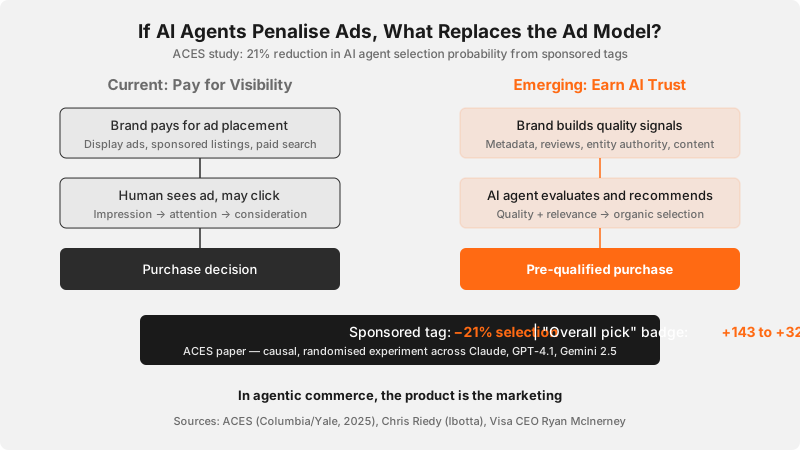
Regardless of which model wins, one finding from the ACES paper holds across all scenarios: seller-side AI agents making minor tweaks to product descriptions can deliver substantial market-share gains. Metadata optimisation works under every monetisation model tested. As we document in our content methodology, the structural elements that M.A.R.C. requires — attributed statistics, expert quotations, answer-first formatting — align precisely with the signals that earn AI citations.
If you’re a business investing in AI visibility, the strategic implication is straightforward — and practical AEO optimisation is where to start. Product quality, structured data, and accurate metadata are the durable investment. Advertising budgets may or may not translate to AI visibility — the evidence shows a penalty, not a premium. But the quality of your product information works in your favour under Google’s Direct Offers, OpenAI’s organic ACP rankings, Criteo’s data-driven recommendations, and the trust-first platforms equally.
The businesses best positioned for whichever model emerges are the ones whose products genuinely deserve to be recommended. In agentic commerce, the product is the marketing.
Frequently Asked Questions
Will digital advertising disappear because of AI agents?
Not entirely. Display ads — banners, interstitials, and pop-ups that rely on human eyeballs — face a structural challenge because AI agents don’t process them. But search advertising, retail media, and intent-based formats are adapting. The $650 billion digital advertising market is not disappearing. Portions of it are shifting toward transaction-based, metadata-driven, and subscription models. How much shifts and how fast is the open question.
How are AI platforms like ChatGPT and Google monetising AI search?
There is no single model. Google is testing intent-based discount offers inside AI Mode. OpenAI runs transaction fees through ACP plus separated display ads on free tiers. Criteo offers commerce data as recommendation infrastructure via MCP. Perplexity abandoned ads entirely for subscriptions. Anthropic committed to an ad-free model at the Super Bowl. The industry split into three camps in February 2026 — ads-compatible, trust-first, and infrastructure — with no consensus emerging yet.
Should businesses invest in advertising or AEO optimisation?
The evidence suggests both, but with different confidence levels. Advertising budgets are a known quantity — they work today, even if their effectiveness in AI-mediated commerce is unproven. AEO optimisation — structured data, metadata quality, entity building — works under every monetisation model currently being tested. The ACES paper found that metadata tweaks deliver measurable market-share gains while sponsored tags reduce selection probability. For businesses with limited budgets, investing in product information quality is the lower-risk bet.
Further Reading
These are independent sources — not Findcraft content:
- ACES Paper: What Is Your AI Agent Buying? — Columbia GSB and Yale. The causal evidence on how agents respond to sponsored content.
- Agentic Commerce Is a Collective Hallucination — Andrew Lipsman. The strongest case against the disruption narrative.
- Commerce at the Limit — Eric Seufert. The bull case for advertising adapting rather than dying.
- AIs Are Highly Inconsistent When Recommending Brands — Rand Fishkin. Data on why AI recommendations may not be reliable enough to replace ads.
- Google’s Direct Offers for AI Mode — Google. The intent-based alternative to display advertising.
- OpenAI’s Approach to Advertising — OpenAI. The dual-layer monetisation rationale.
- Perplexity Stops Testing Advertising — Search Engine Land. The trust-first pivot.
Incentive disclosure: Findcraft is an AI visibility consultancy. We help businesses get found by AI search engines through AEO optimisation — structured data, entity building, and content strategy. We have a commercial interest in AEO being valuable. We’ve included counter-perspectives (Seufert, Lipsman, Fishkin) that challenge the premise that advertising is being disrupted, because honest analysis serves our readers better than advocacy. You should read their arguments directly.
Content methodology: This post was produced through the M.A.R.C. methodology (Machine-Assisted, Research-driven, human-Curated content). AI tools assisted with research synthesis and drafting. A human reviewed all claims, verified all sources, and made all editorial decisions. Every statistic links to its primary source.