Something fundamental is changing about how customers find businesses. If you're a furniture maker, kitchen designer, architect, or any kind of craftsperson in London, this shift affects you directly — and most people in your trade haven't noticed yet.
What's happening
Until recently, every customer journey started in the same place: a Google search bar. You'd type, scroll, compare a few websites, maybe read some reviews. That entire process is being bypassed — and it's happening faster than most people realise.
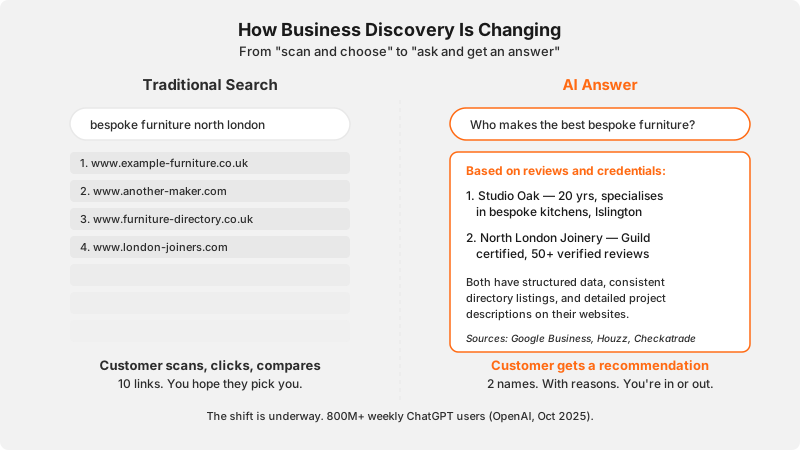
Now, customers are asking AI. They open ChatGPT and type "who makes the best bespoke furniture in North London?" They ask Perplexity "find me a kitchen designer near Islington." They see Google's AI Overview answering their question before they even reach the traditional search results.
Think of it this way: Google works like the Yellow Pages — it lists everyone and leaves you to decide. AI works like asking a knowledgeable friend — it names one or two businesses and explains why. If AI considers you trustworthy enough to recommend, you're the business the customer calls. If it doesn't know you exist, neither will they.
What AI actually says about London craftspeople
We tested this informally in early 2026. We asked ChatGPT, Perplexity, Google AI Overview, and Claude for recommendations across dozens of craft and design specialities in London. The results were instructive — though informal and not reproducible in the way a controlled study would be.
When we asked ChatGPT "who makes the best bespoke furniture in North London," it recommended three businesses. Two of them had extensive structured data on their websites — data that told AI exactly what they do, where they serve, and what their speciality is. The third had dozens of consistent directory listings that AI cross-referenced for credibility.
Meanwhile, furniture makers we know to be more skilled, more experienced, and better reviewed were completely absent. Their websites were beautiful — stunning portfolio images, elegant design — but nothing that AI could actually read or understand.
This pattern repeated across every trade we tested. These are informal observations, not systematic research — but the pattern was consistent enough to be worth noting. The businesses AI recommends aren't always the best. They're the most visible to AI. And right now, "visible to AI" is a very different thing from "visible to humans."
Why most craft websites aren't ready
There's a gap between what makes a website impressive to a human visitor and what makes it useful to an AI engine. Most craft websites were built to showcase work visually — large images, minimal text, clean design. That's great for a customer who's already on your site. It's terrible for AI that's deciding whether to send customers to your site in the first place.
AI needs three things from your website:
- Structured data — think of it as a machine-readable business card hidden in your website's code. Your human visitors never see it, but it tells AI your trade, your location, your specialities, and how to categorise you. Without it, AI is guessing from your page text alone — and it usually guesses wrong.
- Answerable content — text that directly addresses the questions customers ask AI. "What's the best wood for kitchen cabinets?" "How long does a bespoke furniture commission take?" "What should I look for in a kitchen designer?" When your website provides clear, specific answers, AI has something it can point to. When it's just images and a phone number, AI has nothing to work with.
- Consistent presence — your business details need to match across every platform where you're listed. When AI checks your name, address, and services on one site against another and finds the same information, it gains confidence. When details conflict, it moves on to a business it can verify.
The honest caveat
AI search is not a replacement for traditional search — not yet, and possibly not ever in the way some predictions suggest. Google still processes the vast majority of searches, and most customers still use conventional search for local services. AI recommendations also have well-documented accuracy problems: a global study of 48,000 people across 47 countries found that fewer than half are willing to trust AI (University of Melbourne/KPMG, 2025).
The businesses that prepare for AI visibility now will likely benefit — but the scale and speed of the shift remain uncertain. We think it's worth acting on, which is why Findcraft exists. But we'd rather be honest about what we don't know than pretend we have certainty we lack.
Three things you can do this week
You don't need to rebuild your entire online presence overnight. Here are three concrete steps that make a real difference:
1. Test what AI says about you
Open ChatGPT, Perplexity, or Google and ask for your service in your area. Try different phrasings — "reliable joiner for a loft conversion in Hackney," "bespoke cabinet maker East London," "architect for Victorian terrace renovation Islington." See what comes back. If you're not in the answers, that tells you something.
2. Add descriptions to your portfolio
Every project on your website should have a written description — not just images. What was the brief? What materials did you use? What was unique about this project? AI can't see your photos (not yet, not reliably), but it can read your descriptions. A paragraph per project transforms your portfolio from an image gallery AI ignores into a knowledge base AI trusts.
3. Claim and update your directory listings
Start with Google Business Profile — it's free and carries the most weight with AI. Then add whichever trade-specific directory matters for your craft (Houzz for designers, Checkatrade for tradespeople, professional body listings for architects). What matters is that your details match everywhere: if AI finds conflicting information about your business across different sites, it loses confidence in recommending you.
The bigger picture
AI search isn't replacing Google overnight — roughly 60% of searches already end without a click. But the trajectory is clear: more customers are starting their search with AI, and that percentage is growing every month. The businesses that prepare now will have a significant advantage over those that wait.
For craftspeople specifically, this is both a challenge and an opportunity. The challenge is that your current website probably isn't structured for AI. The opportunity is that almost none of your competitors have done anything about it either. The first movers in each trade and area will dominate AI recommendations for months before anyone catches up.
Your craft speaks for itself — to anyone who sees it. The question is whether AI knows enough about you to send those people your way.
When this matters less
If you're just starting out and don't have a body of work yet, this isn't where your energy should go. AI can only recommend what it can verify, and there's nothing to verify until you have completed projects, satisfied clients, and a track record to point to. Build the craft first. Visibility follows substance.
Similarly, if your pipeline is already full from architect referrals or repeat clients — if you're turning work away — then AI visibility is a low priority. It matters most for established craftspeople whose quality of work deserves a wider audience than their current referral network provides.
A note on our perspective
Full transparency: Findcraft sells AI visibility services, so we have a commercial interest in this topic. Everything above — testing, portfolio descriptions, directory listings — works without us. We wrote this because the information gap is real and most craftspeople haven't heard about it yet, not because we need the lead. Judge the advice on its merits and verify it independently.
Frequently asked questions
How do I check what AI says about my business?
Open ChatGPT, Perplexity, or Google and ask for your type of service in your area. Try different phrasings — "best furniture maker in Hackney," "recommended joiner North London," "kitchen designer near Islington." AI gives different answers each time (SparkToro research shows less than 1 in 100 identical responses), so check multiple times across multiple platforms.
Does AI search replace Google?
Not currently. Google still dominates search, and roughly 60% of searches end without a click to any website (SparkToro/Datos, 2024). AI search is an additional channel, not a replacement. But the percentage of customers starting with AI is growing, and being absent from AI answers means being invisible to those customers.
What is structured data and do I need it?
Structured data is code embedded in your website that tells AI exactly what your business does, where you're located, and what services you offer. Your human visitors never see it, but it's how AI categorises and understands your business. Most craft websites don't have it — adding it is one of the highest-impact changes you can make for AI visibility. The standard is called Schema.org LocalBusiness.
Further reading
These are independent sources — none of them are affiliated with Findcraft:
- SparkToro/Datos 2024 Zero-Click Search Study — data on how search behaviour is shifting away from click-through results.
- Schema.org LocalBusiness specification — the structured data standard that helps AI understand your business.
- Google's Structured Data documentation — Google's own guide to implementing structured data on your website.
Want to know where you stand?
We'll test what AI says about your business across ChatGPT, Perplexity, Google AI, and Claude. Free, no strings attached, delivered in 12 hours.
Request Your Free AI AuditFindcraft provides AI visibility services for craftspeople. This article reflects our honest assessment of how AI search is changing business discovery — including the parts that remain uncertain.
Content produced through the M.A.R.C. methodology — our framework for evidence-based, ethically-governed content.