AI visibility is how often and how accurately your business appears in AI-generated responses across ChatGPT, Perplexity, Google AI Overview, Gemini, Claude, and other AI search platforms. Unlike traditional search visibility — which measures your position in a ranked list of links — AI visibility measures whether AI mentions, recommends, or cites your business when users ask questions relevant to what you do.
Why Does AI Visibility Matter for Businesses?
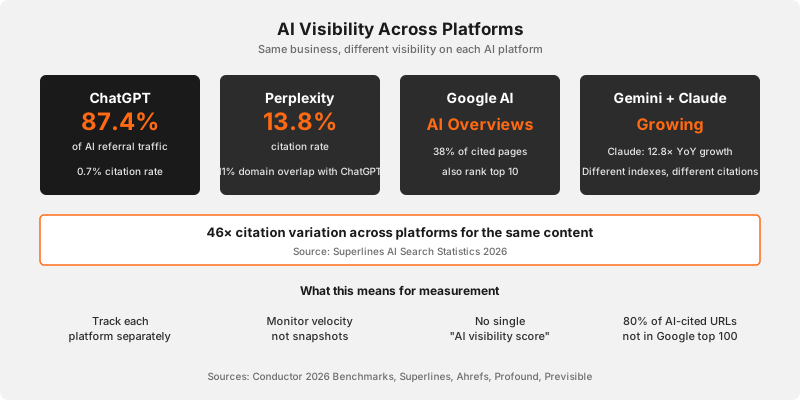
The discovery shift is already measurable. Conductor’s 2026 benchmarks (13,770 domains, 3.3 billion sessions) show that 87.4% of AI referral traffic comes from ChatGPT alone. AI referral traffic currently accounts for 1.08% of total website traffic — small in absolute terms, but growing rapidly and representing a fundamentally different discovery channel where AI selects which businesses users see.
As we explored in our analysis of agentic commerce, this shift extends beyond search into commerce itself — AI agents are beginning to discover, evaluate, and transact on behalf of users. Businesses invisible to AI today risk being invisible to an entirely new category of customer.
How Is AI Visibility Different From SEO Rankings?
The signals are different. Ahrefs research found that 80% of URLs cited by AI don’t rank in Google’s top 100 for the same query. Ranking well on Google does not guarantee AI will cite you. Conversely, AI may cite sources Google considers low-authority — because AI evaluates content differently, weighting entity consistency, answer-first structure, and cross-platform verification.
Our own experience illustrates this directly: Findcraft holds #1 organic on Google for a target query but has 0% citation in the AI Overview above it. The gap between search ranking and AI citation is not theoretical — it’s measurable and consequential.
Can You Measure AI Visibility Accurately?
Not with a single number. As we documented in The AI Referral Paradox, citation rates vary 46× across platforms, visibility can decline 35% in five weeks without any content changes, and only 11% of domains cited by ChatGPT also appear in Perplexity.
The practical approach is to track each platform independently and monitor the velocity of change rather than point-in-time snapshots. Free tools — GA4 custom channel groups, Bing Webmaster Tools AI reports, Google Search Console — can track AI referral traffic at no cost. Paid tools like Profound, Otterly, and Rankability add mention tracking across AI responses.
What Drives AI Visibility?
Entity authority is the primary driver. AI engines recommend businesses they can verify and trust — which requires consistent information across multiple sources. Structured data (schema markup), reviews on trusted platforms, directory presence, quality content, and backlinks all contribute. For a detailed breakdown, see our AEO definition and our guide on how AI decides which businesses to recommend.
For businesses looking to improve their AI visibility, our free AI Visibility Audit shows exactly where you stand across AI platforms — and where the gaps are.
Frequently Asked Questions
What is the difference between AI visibility and SEO rankings?
SEO rankings measure your position in Google’s list of links. AI visibility measures whether AI engines mention, recommend, or cite your business in their generated responses. 80% of URLs cited by AI don’t rank in Google’s top 100 for the same query — the two systems reward different signals.
Can you measure AI visibility accurately?
Not with a single metric. Citation rates vary 46× across platforms. Only 11% of domains cited by ChatGPT also appear in Perplexity. The most reliable approach is to track each platform independently and monitor the velocity of change rather than point-in-time snapshots.
How much does AI visibility tracking cost?
Paid AI visibility tools average $337 per month. Free alternatives exist: GA4 custom channel groups can segment AI referral traffic, Bing Webmaster Tools provides AI traffic reports, and Google Search Console surfaces AI Overview data. These won’t track brand mentions in AI responses, but they show traffic that reaches your site.
Further Reading
- 2026 AEO/GEO Benchmarks Report — Conductor. The definitive AI traffic baseline.
- AI Search Overlap Study — Ahrefs. Data showing 80% of LLM citations don’t rank in Google’s top 100.
- AI Search Statistics 2026 — Superlines. Citation variation and visibility decline data.
- How Much Should You Pay for AI Visibility Tools? — Rankability. Market pricing analysis.
Incentive disclosure: Findcraft is an AI visibility consultancy. We provide the services discussed on this page. Read accordingly, verify independently, and trust your own judgement.
Content methodology: This page was produced through the M.A.R.C. methodology (Machine-Assisted, Research-driven, human-Curated content). AI tools assisted with research synthesis and drafting. A human reviewed all claims, verified all sources, and made all editorial decisions.