Entity authority is the strength and consistency of your business’s identity across the web, as perceived by AI search engines. It determines whether ChatGPT, Perplexity, Google AI Overview, and other platforms recommend your business when users ask relevant questions. Entity authority is built through structured data (schema markup), reviews on trusted platforms, consistent directory listings, brand mentions in third-party content, and quality backlinks — converging signals that give AI confidence to put your name forward.
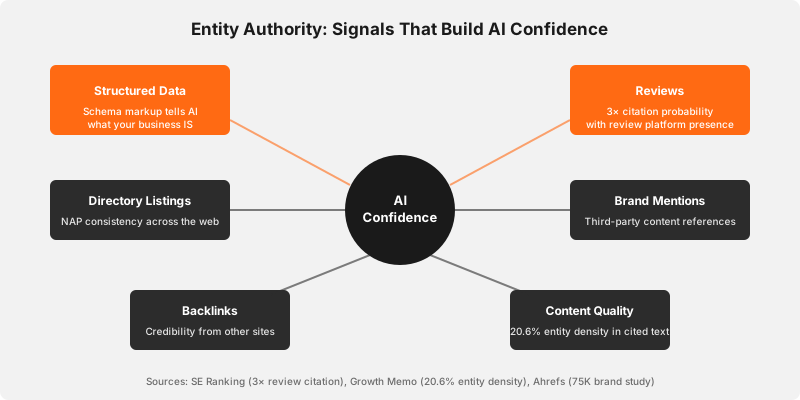
What Signals Build Entity Authority?
AI engines don’t rank pages — they evaluate entities. A business is an entity: a thing with attributes (name, location, services, reputation) that AI can verify across multiple sources. The more sources that agree, the higher the entity authority.
Structured data is the foundation. Schema markup tells AI explicitly what your business is, what you do, and where you operate. Without it, AI has to guess — and guessing reduces confidence. Reviews serve as independent verification: SE Ranking research found that businesses with review platform presence (Trustpilot, G2, Yelp) have 3× higher AI citation probability. Directory listings provide NAP consistency (name, address, phone) that AI cross-references. Brand mentions in third-party content and backlinks signal that other credible sources recognise your business.
We explored these signals in practical detail in our guide on how AI decides which businesses to recommend.
Why Do Big Brands Dominate AI Recommendations?
Ahrefs’ study of 75,000 brands found a 0.779 output overlap correlation across AI platforms — the same dominant brands appear regardless of which AI you ask. This concentration reflects entity authority compounding: large brands have more reviews, more directory listings, more brand mentions, and more backlinks. AI cites them because the evidence is overwhelming and consistent.
This doesn’t mean small businesses are locked out. It means the path is different. A local business with 30 genuine reviews, accurate schema markup, and consistent directory listings can outperform a larger competitor with inconsistent information. AI prefers verifiable consistency over raw scale. Whether the incumbency advantage can be overcome systematically is a question we’re actively researching.
How Can Small Businesses Build Entity Authority?
Start with the signals that are entirely within your control. Implement structured data on your website — LocalBusiness, Service, FAQ, and Article schema at minimum. Claim your Google Business Profile and ensure all information matches your website exactly. Register on review platforms — Trustpilot is the most-cited by UK AI queries, but Google reviews carry weight too. Ensure NAP consistency across every directory listing.
Then build the signals that depend on others: quality content that earns mentions, genuine relationships that produce backlinks, and service delivery that generates reviews. These compound over time. Our AEO service covers the full implementation from technical foundations to ongoing entity building.
Does Content Quality Matter More Than Entity Authority?
Both matter, but they serve different functions. Entity authority determines whether AI considers you at all. Content quality determines what AI extracts and cites. Growth Memo’s analysis of 1.2 million ChatGPT citations found that cited text has 20.6% entity density versus 5–8% baseline, and 44.2% of all citations come from the first 30% of a page.
The implication: entity authority gets you into the consideration set, and content quality determines what gets cited. A business with strong entity authority but poor content will be mentioned but not quoted. A business with excellent content but weak entity authority may never be considered. Both layers are necessary. For a full breakdown of how these signals interact, see our AEO definition.
Frequently Asked Questions
What is entity authority in AI search?
Entity authority is the strength and consistency of your business’s identity across the web, as perceived by AI engines. It’s built through structured data, reviews on trusted platforms, consistent directory listings, brand mentions in third-party content, and quality backlinks. The stronger your entity authority, the more confident AI becomes in recommending you.
How long does it take to build entity authority?
Entity authority builds over months, not weeks. Structured data and directory consistency can be established in weeks. Reviews accumulate over months. Brand mentions and backlinks compound over time. There is no shortcut — entity authority reflects genuine business presence across the web.
Do reviews really affect AI recommendations?
Yes. SE Ranking research found that businesses with review platform presence have 3× higher AI citation probability. Reviews serve as independent verification of business quality — exactly the signal AI needs to recommend with confidence.
Further Reading
- AI Brand Visibility Correlations — Ahrefs. 75,000-brand study showing citation concentration patterns.
- How to Optimize for ChatGPT — SE Ranking. Review platform presence and 3× citation rate data.
- The Science of How AI Pays Attention — Kevin Indig, Growth Memo. 1.2 million citation analysis.
Incentive disclosure: Findcraft is an AI visibility consultancy. We provide the services discussed on this page. Read accordingly, verify independently, and trust your own judgement.
Content methodology: This page was produced through the M.A.R.C. methodology (Machine-Assisted, Research-driven, human-Curated content). AI tools assisted with research synthesis and drafting. A human reviewed all claims, verified all sources, and made all editorial decisions.