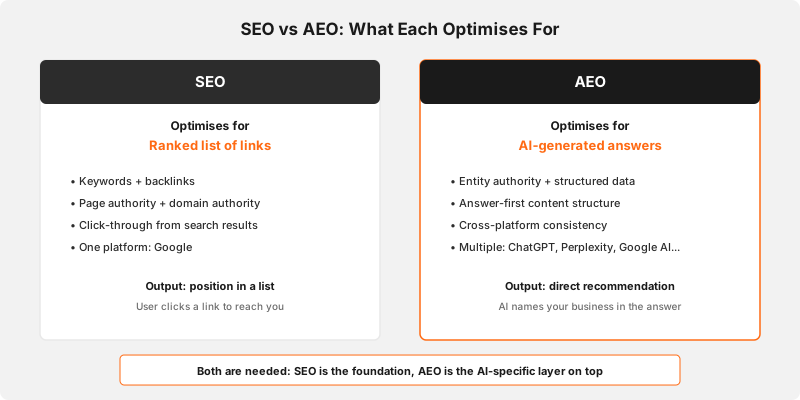
Answer Engine Optimisation (AEO) is the practice of making your business visible to AI search engines — ChatGPT, Perplexity, Google AI Overview, Gemini, and Claude — so they recommend you when users ask questions. Where traditional SEO optimises for Google’s ranked list of links, AEO optimises for AI-generated answers that synthesise information from multiple sources and present a direct recommendation.
How Does AEO Differ From SEO?
SEO and AEO are complementary, not competing. SEO remains the foundation — without proper indexing, site speed, and quality content, AI engines have nothing to cite. AEO adds the layer that makes your content extractable by AI: answer-first structure, entity signals, and cross-platform consistency.
The critical difference is in what gets rewarded. SEO rewards pages that match keyword intent and earn backlinks. AEO rewards content that AI can confidently synthesise into a direct answer. As we documented in our analysis of platform fragmentation, AI search isn’t one system — it’s at least three, each with different citation patterns. A page ranking #1 on Google may never appear in ChatGPT’s responses, because the signals AI uses to select sources differ fundamentally from Google’s ranking algorithm.
What Signals Do AI Engines Use to Recommend Businesses?
AI engines build confidence in a business through multiple converging signals. Entity authority — the strength and consistency of your business’s identity across the web — is the primary driver. This includes structured data (schema markup that tells AI what your business is), reviews on trusted platforms, consistent directory listings, brand mentions in third-party content, and quality backlinks.
We explored these recommendation factors in detail in our guide on how AI decides which businesses to recommend. The short version: AI needs to understand what you do, trust that you’re good at it, and find consistent information about you everywhere it looks. Most business websites give AI none of these three things.
How Do You Measure AEO Success?
Measuring AEO is harder than measuring SEO — and the industry hasn’t settled on reliable methods yet. Citation rates vary 46× across AI platforms. Visibility can decline 35% in five weeks without any change to your content. Only 11% of domains cited by ChatGPT also appear in Perplexity.
We documented the full measurement challenge in The AI Referral Paradox and compared the emerging tracking tools in our AI visibility overview. The practical approach: track each platform independently, monitor velocity of change rather than point-in-time snapshots, and use free tools like GA4 custom channel groups to segment AI referral traffic before investing in paid trackers.
Should Small Businesses Invest in AEO?
The case for starting now is structural, not urgent. AI referral traffic currently accounts for about 1% of total website traffic, so this is not yet a crisis for most businesses. But the fundamentals of AEO — structured data, review platform presence, answer-first content, consistent directory listings — benefit traditional search as well. You’re not betting on AI; you’re building a stronger digital presence that happens to prepare you for AI at the same time.
For businesses considering their options, our AEO service covers the full implementation — from structured data to content architecture to directory consistency.
Frequently Asked Questions
Is AEO replacing SEO?
No. AEO builds on top of SEO foundations. Structured data, quality content, and technical performance all remain essential. AEO adds the AI-specific layer — answer-first content, entity signals, and cross-platform consistency — that helps AI engines understand and recommend your business.
How long does AEO take to show results?
Initial improvements typically appear within 4–6 weeks as AI engines re-index updated content and structured data. Full entity authority builds over 3–6 months. Unlike SEO, where ranking positions shift gradually, AI citations can appear (or disappear) rapidly as platforms update their models.
Do small businesses need AEO?
The case for starting now is structural, not urgent. AI referral traffic currently accounts for about 1% of total website traffic, but AI-influenced discovery — where users ask AI then search directly — doesn’t appear in referral data. The cost of AEO fundamentals (structured data, review platforms, content quality) is low, and these improvements benefit traditional search as well.
Further Reading
- 2026 AEO/GEO Benchmarks Report — Conductor. 13,770 domains, 3.3 billion sessions. The definitive AI traffic baseline.
- AAO: Assistive Agent Optimization — Greg Bernhardt, Search Engine Land. Overview of the six competing terms for the discipline.
- AI Search Statistics 2026 — Superlines. Comprehensive compilation including citation variation and visibility decline data.
Incentive disclosure: Findcraft is an AI visibility consultancy. We provide the services discussed on this page. Read accordingly, verify independently, and trust your own judgement.
Content methodology: This page was produced through the M.A.R.C. methodology (Machine-Assisted, Research-driven, human-Curated content). AI tools assisted with research synthesis and drafting. A human reviewed all claims, verified all sources, and made all editorial decisions.