The AI visibility measurement paradox is the finding that AI referral traffic data contradicts itself depending on who measures it, which platforms they track, and how they define conversion. Across fourteen independent datasets from sources including Search Engine Land, Amsive Digital, Ahrefs, and Conductor, three statements are simultaneously true: ChatGPT and Perplexity referrals show the highest conversion rates ever recorded, citation patterns vary 615× across platforms with only 11% domain overlap, and no two measurement methodologies produce consistent results.
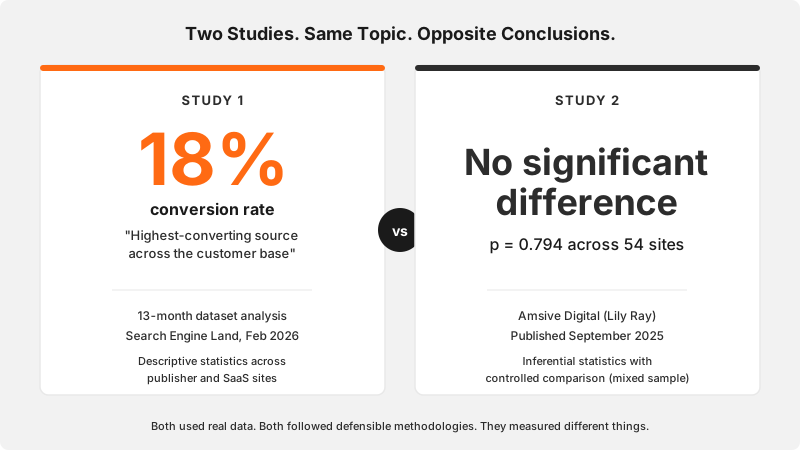
AI search traffic converts at approximately 18% — the highest-converting source across the study’s customer base — according to a 13-month dataset analysis published by Search Engine Land in February 2026. The same month, the only study with proper inferential statistics found no significant difference from organic traffic at all (p = 0.794, across 54 sites). Both used real data. Both followed defensible methodologies. They cannot both be right in the way each headline implies — and understanding why they disagree matters more than picking a winner.
In our last analysis, we asked whether we can even measure what’s working in AI search. We’ve now examined fourteen independent datasets. The answer is yes — but the measurements contradict each other depending on who measured what, how they defined “conversion,” and which platforms they tracked. Three things are simultaneously true about AI search traffic: it’s the best-converting traffic ever measured, you can’t reliably get it, and you can’t accurately measure it. The tension between these three statements is not a problem to solve. It’s the strategic reality.
Does AI Traffic Actually Convert Better?
The headline conversion figures are extraordinary — and they pull in opposite directions.
The bull case: Jason Tabeling’s 13-month analysis, published in Search Engine Land, tracked LLM-referred traffic across a portfolio of sites and found an 18% conversion rate — the highest of any traffic source measured. LLM referral traffic tripled over 2025, though it still represents less than 2% of total referral traffic. Separately, Microsoft Clarity data showed AI-referred visitors converting at 3× the rate of organic visitors, with Copilot-referred traffic converting at 17× the rate of direct traffic — specifically for publisher subscriptions and content sign-ups.
The bear case: Lily Ray and the Amsive team conducted what remains the only study with proper inferential statistics — 54 sites, controlled comparison, published September 2025. Result: p = 0.794. No statistically significant difference between LLM-referred and organic conversion rates. For ecommerce sites specifically, AI traffic underperformed organic for actual purchase transactions.
These studies don’t contradict each other as much as they appear to. They measured different things. Tabeling’s 18% figure uses a broad conversion definition across publisher and SaaS sites — sign-ups, newsletter subscriptions, free trial activations. Microsoft’s 17× Copilot figure comes from their own browser on publisher sites. Amsive’s study used proper statistical controls on a mixed sample that included ecommerce, where the conversion event is an actual purchase.
The pattern that emerges — and this is our interpretation, not established fact — is a channel maturity signature. AI search delivers conviction-ready users. They’ve already evaluated options through conversation with an LLM. They arrive ready to commit. That makes them excellent at low-friction conversions: signing up, subscribing, starting a free trial. But for high-friction transactions — entering payment details, choosing between variants, completing a purchase — they underperform. This aligns with the 18-day vs 29-day closing data from StudioHawk — AI delivers conviction-ready leads, but the conviction works better for commitment than for cold commerce. The AI conversation replaces the comparison-shopping phase that builds purchase confidence, and without that phase, purchase intent doesn’t fully form. The traffic converts brilliantly for commitment. It underperforms for commerce. This is a reasonable inference from the available data, not an established fact.
Why Can’t Anyone Get Consistent AI Recommendations?
Even if AI traffic converts well, getting it consistently is another problem entirely.
Rand Fishkin’s team at SparkToro ran 2,961 repeated tests across AI platforms in January 2026 and found that fewer than 1 in 100 queries returned the same brand list. The inconsistency wasn’t random noise — it was structural. Different sessions, different phrasings, and even the same prompt on the same platform produced materially different recommendations.
Ahrefs’ study of 75,000 brands found that the same dominant brands (Nike, Apple, Amazon) appear across all AI platforms despite different selection mechanisms — with a 0.779 output overlap correlation showing that brand authority concentrates citations in a small number of names. Meanwhile, Superlines data showed a 36% decline in AI visibility scores over just five weeks — meaning even brands that achieve high citation rates can lose them rapidly.
Taken together, this means snapshot measurements of AI visibility are structurally unreliable — low consistency across queries combined with rapid decay over time makes any single reading close to meaningless.
What determines which brands reach that dominant tier? Kevin Indig’s Growth Memo research analysed 1.2 million ChatGPT responses, isolating 18,012 verified citations, and found that 44.2% of all citations come from the first 30% of a page’s text — a “ski ramp” distribution where front-loaded content dominates. More striking: cited text has 20.6% entity density compared to a 5–8% baseline. AI engines aren’t reading pages the way humans do. They’re scanning for entity-rich, claim-dense text concentrated near the top.
The implication is uncomfortable: the brands that dominate AI recommendations are the ones with strong entity authority — recognised names, structured data, presence across review platforms — not necessarily the ones with the best content or the most pages. And the tens of millions being invested in AI visibility tracking tools may be measuring noise if the underlying visibility shifts this fast.
Is ‘AI Visibility’ Even One Thing?
The consistency problem becomes worse when you realise “AI search” is not a single channel. Superlines documented a 615× variation in citation rates across platforms for the same content, and a 14.8× variation in sentiment — meaning the same brand can be recommended enthusiastically by one AI engine and dismissed by another.
The overlap numbers tell the same story from a different angle. Only 11% of domains cited by ChatGPT also appear in Perplexity according to Profound’s analysis of hundreds of millions of citations across AI platforms. Only 13.7% of URLs shown in Google AI Overviews also appear in Google’s AI Mode per Ahrefs’ cross-platform analysis (December 2025). These are not variations of the same ranking system. They are fundamentally different recommendation engines with different training data, different architectures, and different citation behaviours.
The downstream effects are already measurable. Reuters Institute research (January 2026) found that publishers expect a further 43% decline in search traffic over the next three years, with Chartbeat data already showing Google organic traffic to news sites down 33% year-over-year. Semrush’s analysis of 69 million sessions found that 92–94% of Google AI Mode searches were zero-click — users got their answer without visiting any website at all. Traffic is declining and the traffic that remains is harder to attribute. Both problems are getting worse simultaneously.
As we noted in our earlier analysis of platform fragmentation, the six competing terms for this discipline — AEO, GEO, LLMO, AAO, SGE, AIO — are not just a branding problem. They reflect genuine uncertainty about what’s being optimised. When citation variation spans 615× across platforms, the question isn’t which term to use. It’s whether a single metric can describe what’s happening.
What Should Businesses Actually Do With This Data?
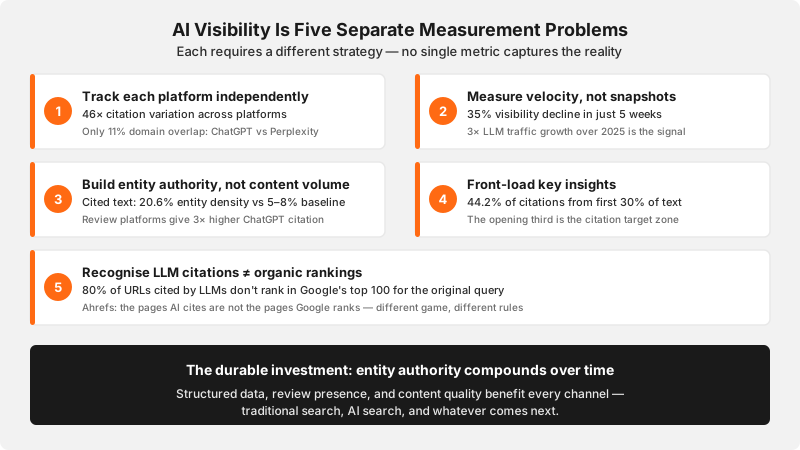
First, stop treating AI visibility as a single metric. It’s at least five separate optimisation problems — one per major platform — and each responds to different content signals. A strategy that works for ChatGPT citations may have no effect on Perplexity or Google AI Mode.
Second, monitor velocity rather than snapshots. The 3× growth over 2025 (January to December) in LLM referral traffic matters more than any individual query test. Point-in-time measurements of AI visibility are unreliable — Superlines showed 36% decline in five weeks. Trend direction is the signal; absolute position is noise.
Third, invest in entity authority over content volume. The Ahrefs data showing brand authority concentrating citations among dominant names, combined with Growth Memo’s finding of 20.6% entity density in cited text, points to the same conclusion: AI engines cite recognised entities, not comprehensive content. SE Ranking research found that domains with profiles on review platforms like Trustpilot, G2, Capterra, Sitejabber, and Yelp have 3× higher chances of ChatGPT citation. Directory presence is a citation multiplier.
Fourth, front-load your key insights. With 44.2% of citations pulled from the first 30% of text, the opening third of every page is the citation target zone. Write it as if it will be extracted and quoted without context — because in AI search, it will be.
And fifth, recognise that this is a fundamentally different game from traditional SEO. Ahrefs found that 80% of URLs cited by LLMs don’t rank in Google’s top 100 for the original query. The pages AI engines cite are not the pages Google ranks. LLM referrals still represent less than 2% of total referral traffic — but they’re growing at 3× over 2025, and if the channel maturity thesis holds, they convert very differently from organic.
The urgency is not about AI traffic replacing organic — it isn’t, yet. It’s about organic itself declining, a trend we first documented in our zero-click analysis. With 92–94% zero-click rates in AI Mode, publishers projecting a 43% decline in search traffic, and LinkedIn B2B referral traffic down 60%, the traditional channels are eroding faster than the new ones are maturing. The businesses with the strongest entity foundations will be best positioned regardless of which channels ultimately dominate.
The Case for Doing Nothing
The sceptic position deserves its strongest framing, because the data genuinely supports caution. Lily Ray, VP of SEO Strategy & Research at Amsive, has been among the most vocal sceptics — her team’s study is the only one in the field that applied proper inferential statistics, and she has publicly questioned the rush to sell “rank #1 in ChatGPT” courses and playbooks. Her position — that the field is building commercial offerings on unproven foundations — is supported by the data contradictions documented here.
As of early 2025, Google sent approximately 345× more traffic to websites than all AI platforms combined. LLM referrals account for approximately 0.02% of publisher traffic according to the Reuters Institute. Even Tabeling’s own data — the study with the impressive 18% conversion figure — acknowledges LLM traffic is less than 2% of total referral traffic. You are looking at a rounding error and calling it a revolution.
The 18% conversion rate itself is descriptive, not inferential. There are no confidence intervals. There is no control group. The sample composition is undisclosed. Microsoft’s 3×/17× Copilot conversion data comes from their own browser tracking publisher sites — the most self-serving sample in the entire dataset. It tells you that people who use Microsoft’s AI product through Microsoft’s browser subscribe to things at a high rate. The leap to “AI traffic converts better” is not supported by that methodology.
Meanwhile, Lily Ray’s Amsive study is the only research with proper statistical testing — inferential statistics, controlled comparison, published methodology — and it found no significant difference (p = 0.794). If you had to bet on one study being methodologically sound, you’d pick the one that actually controlled for confounding variables. And it found nothing.
The sample sizes across all these studies are small relative to the claims being made about them. The SparkToro consistency data covers 2,961 tests — meaningful for brand-level analysis, but not a basis for allocating marketing budgets. The smart move, the sceptic argues, is to wait until the data matures before investing real resources in what may be noise.
The counter to this is structural, not statistical. The brands establishing entity authority now are the ones who will occupy the dominant positions when the channel scales. Entity authority compounds — it’s built through years of structured data, review presence, and consistent information architecture, not through campaign sprints. Waiting for mature data means competing against entrenched players who started earlier. And the cost of AEO optimisation is low: structured data, entity building, and content quality improvements benefit traditional search regardless of whether AI traffic materialises at scale. But the sceptic’s core point stands — the current evidence base is thinner than most headlines suggest.
Uncomfortable Questions We’re Still Working Through
The robots.txt dilemma has no good answer. BuzzStream research found that 79% of top news sites now block at least one AI training bot. But 71% also block at least one search and retrieval bot — the bots that find content to cite, not just to train on. The technical architecture doesn’t cleanly separate these functions. Anthropic runs three bots with different purposes. OpenAI runs three. Blocking training may also block citation. But not blocking training means contributing to systems that may replace your traffic. The cost of getting this wrong is invisible — you never know what citations you were excluded from. We’re looking at this data more closely.
AI recommendation poisoning is already here. Microsoft researchers via MarketingProfs identified 31 companies making 50 distinct prompt injection attempts to manipulate AI recommendations. If brands can influence what LLMs recommend through invisible manipulation, what does that do to the conversion data we’re measuring? The agentic commerce numbers paradox already showed how the same label covers three different phenomena — recommendation poisoning adds a fourth dimension of confusion. How much of the “organic” AI traffic is actually influenced by poisoned inputs?
Is “AI visibility” a coherent concept? With 615× citation variation across platforms, 36% visibility decline in five weeks, and 6+ competing terms for the same discipline, we may be measuring five separate phenomena under a single label — and building strategies around a metric that doesn’t describe anything real.
A note on scope: This analysis focuses on ChatGPT, Google AI (Overviews and AI Mode), and Perplexity — the three platforms most studied by the citation research firms whose data we synthesise. Claude (Anthropic) is the fourth major AI platform by referral traffic, growing 12.8× year-over-year according to Previsible’s 1.96 million session analysis, with a 5% conversion rate (Seer Interactive, June 2025). It uses Brave Search’s index rather than Google’s or Bing’s, with 86.7% citation overlap to Brave’s results. Claude is largely absent from the major citation studies we reference — a gap in the industry’s analysis that this post inherits rather than corrects.
Frequently Asked Questions
Does AI search traffic convert better than organic search traffic?
It depends on what you mean by “convert.” A 13-month dataset analysis found an 18% conversion rate for LLM-referred traffic — the highest of any channel measured. But the only study with proper inferential statistics (p = 0.794, 54 sites) found no significant difference from organic. The contradiction resolves through conversion type: AI traffic converts brilliantly for sign-ups and subscriptions but underperforms for direct ecommerce purchases.
How do you measure AI visibility when results are inconsistent?
You measure it as at least five separate problems, not one. Citation rates vary 615× across platforms, sentiment varies 14.8×, and only 11% of domains overlap between ChatGPT and Perplexity. Monitor velocity of growth rather than point-in-time snapshots, and track each platform independently rather than relying on any single “AI visibility score.”
Should small businesses invest in AI search optimisation now or wait?
The case for starting now is structural, not urgent. Brand authority concentrates citations among a small number of dominant names, and that authority compounds over time. The cost of optimisation — structured data, review platform presence, content quality — is low and benefits traditional search regardless. A monthly visibility programme can track these gains across platforms as they compound. But LLM referrals are still under 2% of total referral traffic, so this should complement your existing strategy, not replace it.
Why do different studies show contradictory AI traffic conversion rates?
Three reasons: different definitions of “conversion” (sign-ups vs purchases vs page engagement), different sample compositions (publisher sites vs ecommerce vs mixed), and different methodologies (descriptive statistics vs inferential testing). The 18% figure uses a broad conversion definition across publisher and SaaS sites. The p = 0.794 finding uses proper statistical controls on a mixed sample. Neither is wrong — they measured different things.
Further Reading
These are independent sources — not Findcraft content:
- What 13 Months of Data Reveals About LLM Traffic Growth and Conversions — Jason Tabeling, Search Engine Land. The dataset analysis behind the 18% conversion figure.
- New Research: AIs Are Highly Inconsistent When Recommending Brands — Rand Fishkin, SparkToro. The brand consistency study across 2,961 tests.
- Does LLM Traffic Convert Better Than Organic? A New Data-Backed Study — Lily Ray, Amsive. The only study with proper inferential statistics.
- The Science of How AI Pays Attention — Kevin Indig, Growth Memo. Analysis of 1.2 million ChatGPT responses (18,012 verified citations).
- AI Search Overlap Study — Ahrefs. Data showing 80% of LLM citations don’t rank in Google’s top 100.
- AI Search Statistics 2026 — Superlines. Comprehensive compilation including 615× citation variation and 36% visibility decline.
- Google AI Mode SEO Impact — Semrush. Analysis of 69 million sessions showing 92–94% zero-click rates.
- Citation Overlap Strategy — Profound. Citation overlap analysis showing 11% domain overlap between ChatGPT and Perplexity.
- AI Brand Visibility Correlations — Ahrefs. Study of 75,000 brands showing 0.779 output overlap correlation across AI platforms.
- Journalism, Media, and Technology Trends and Predictions 2026 — Reuters Institute. Projected 43% search traffic decline for publishers.
- Publishers Blocking AI Study — BuzzStream. Data on 79% of top news sites blocking at least one AI training bot.
- AAO: Assistive Agent Optimization — Greg Bernhardt, Search Engine Land. Overview of the six competing terms for the discipline.
- AI Traffic Converts at 3× the Rate of Other Channels — Microsoft Clarity. Copilot conversion data (3×/17×) for publisher subscriptions.
- AI SEO Study 2025 — Previsible. Analysis of 1.96 million sessions including Claude’s 12.8× year-over-year growth.
- How to Optimize for ChatGPT — SE Ranking. Research showing 3× higher citation rates for brands with review platform presence.
Incentive disclosure: Findcraft is an AI visibility consultancy — we help businesses get found by AI search engines and we benefit commercially when businesses invest in AI visibility. That’s a conflict of interest worth naming. We’ve presented the sceptic case in Section 6 in its strongest form — including the argument that the smart move is to wait — because honest analysis serves our readers better than advocacy. The channel maturity interpretation in Section 2 is our inference, not established fact. Read the primary sources directly, verify independently, and trust your own judgement.
Content methodology: This post was produced through the M.A.R.C. methodology (Machine-Assisted, Research-driven, human-Curated content). AI tools assisted with research synthesis and drafting. A human reviewed all claims, verified all sources, and made all editorial decisions. Every statistic links to its primary source.