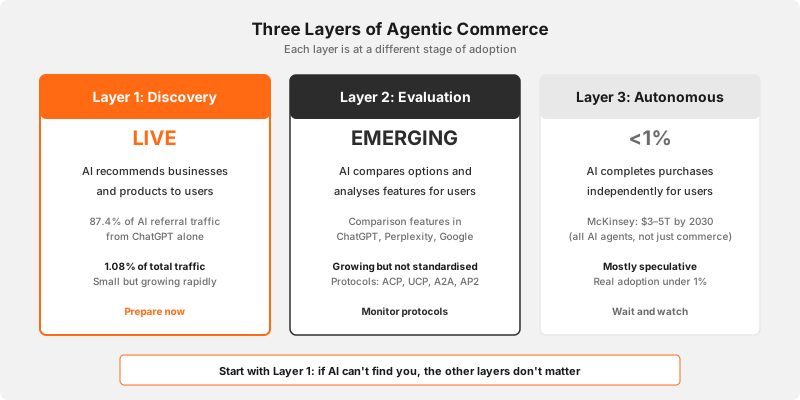
Agentic commerce is the use of AI agents to discover, evaluate, and purchase products or services on behalf of users. It operates across three distinct layers: AI-assisted discovery (where AI recommends businesses and products), AI-assisted evaluation (where AI compares options and analyses features), and fully autonomous transactions (where AI completes purchases independently). The term “agentic commerce” covers all three layers — which is why market projections range from billions to trillions depending on which layer the analyst includes.
What Are the Competing Commerce Protocols?
Two major protocols have emerged to standardise how AI agents interact with commerce systems. The Agentic Commerce Protocol (ACP), launched by OpenAI and Stripe in September 2025 under Apache 2.0 licence, focuses on payment and transaction infrastructure for AI agents. The Universal Commerce Protocol (UCP), announced by Google and partners in January 2026, covers the full commerce lifecycle from discovery through fulfilment.
These are complemented by two interoperability protocols: Agent2Agent (A2A), launched by Google in April 2025 with 50+ partners, enables agent-to-agent communication; and Agent Payments Protocol (AP2), also from Google (September 2025, 60+ organisations), handles the payment layer specifically. These are four different protocols solving different parts of the problem — a distinction that matters because industry commentary frequently conflates them. We covered the full protocol landscape in our agentic commerce analysis.
Is Agentic Commerce Actually Happening?
Layer 1 (AI-assisted discovery) is live and measurable. Conductor’s 2026 benchmarks show 87.4% of AI referral traffic comes from ChatGPT, and AI referral traffic accounts for 1.08% of total website traffic. This is genuine AI-assisted discovery at scale, even if the absolute numbers remain small relative to traditional search.
Layer 3 (fully autonomous transactions) remains under 1% of commerce by any credible measure. McKinsey projects $3–5 trillion in value from agentic AI by 2030, but that figure encompasses all AI agent activity, not just commerce. The gap between projection and reality is the central tension we documented in our analysis: the same label covers a measurable present (discovery) and a speculative future (autonomous purchasing).
How Does Agentic Commerce Affect Advertising?
AI agents penalise sponsored content. The ACES study (UC Berkeley, KAIST, AI2) found that five AI models measurably discounted sponsored products when making recommendations. This has profound implications for a $650 billion digital advertising ecosystem built on the assumption that paid placement drives discovery.
For businesses, this shifts the value proposition from visibility through advertising to visibility through entity authority — the signals that AI trusts as genuine rather than paid. The businesses that will thrive in agentic commerce are those AI recommends because they’re genuinely good, not because they paid for placement.
What Should Businesses Do About Agentic Commerce?
Preparation operates across the same three layers. Discoverability: ensure AI can find and understand your business through structured data, entity authority, review platform presence, and AEO fundamentals. Evaluability: make your products and services easy for AI to compare — transparent pricing, accurate specifications, comparison-friendly content. Transactability: clean checkout flows, accessible product data, and readiness for protocol integration when it matures.
Most businesses should start with discoverability. If AI can’t find you, the other layers don’t matter. Our AEO service focuses on this foundation — the practical work that makes your business visible to AI today, regardless of how quickly the autonomous transaction layer matures.
Frequently Asked Questions
What is agentic commerce?
Agentic commerce is the use of AI agents to discover, evaluate, and purchase products or services on behalf of users. It operates across three layers: AI-assisted discovery (recommendations), AI-assisted evaluation (comparison and analysis), and fully autonomous transactions (AI completing purchases independently).
Is agentic commerce actually happening right now?
Layer 1 (AI-assisted discovery) is live and measurable — 87.4% of AI referral traffic comes from ChatGPT. Layer 2 (AI-assisted evaluation) is emerging. Layer 3 (fully autonomous transactions) remains under 1% of commerce. The “agentic” label covers all three, which is why market projections vary so dramatically.
What should businesses do to prepare for agentic commerce?
Focus on three layers: discoverability (structured data, entity authority, review presence), evaluability (transparent pricing, accurate product information), and transactability (clean checkout flows, API-accessible product data). Most businesses should start with discoverability — if AI can’t find you, the other layers don’t matter.
Further Reading
- 2026 AEO/GEO Benchmarks Report — Conductor. AI referral traffic baseline data.
- ACES: Agentic Commerce Evaluation Suite — UC Berkeley, KAIST, AI2. The study showing AI agents penalise sponsored content.
- State of GEO Q1 2026 — Superlines. Market overview including funding and adoption data.
Incentive disclosure: Findcraft is an AI visibility consultancy. We provide the services discussed on this page. Read accordingly, verify independently, and trust your own judgement.
Content methodology: This page was produced through the M.A.R.C. methodology (Machine-Assisted, Research-driven, human-Curated content). AI tools assisted with research synthesis and drafting. A human reviewed all claims, verified all sources, and made all editorial decisions.